How to Build a Daily Devotional Time That Lasts (Even With a Full Schedule)
By The Peony Club Team7 min read
You don't need a perfect hour or a Pinterest-worthy corner. You need a simple plan that survives the chaotic weeks — and that's exactly what we're building here.
A few years ago I bought a new Bible, a beautiful journal and three different coloured pens. I was convinced that was all I needed to finally keep a consistent devotional time. Two weeks later, the journal was buried under a pile of laundry waiting to be folded.
The problem was never the supplies. It was the plan — or rather, the lack of one. I learned that a devotional time that survives chaotic weeks isn't the prettiest one, it's the simplest.
Why devotional time fails (and it isn't a lack of faith)
If you've ever felt guilty for missing several days in a row, let me start here: it usually isn't a lack of love for God. It's three very practical things.
First, the plan is too big. We decide to read four chapters, write half a page of reflection and pray for twenty minutes. On a good day, it works. On a real day, we never even start.
Second, it has no time and no place. "Whenever I can" is a schedule that never arrives. Life always fills the empty spaces.
Third, we treat missing as failing. We skip three days and conclude that "it's not working any more". But consistency isn't a perfect line — it's the ability to come back quickly.
In the morning, Lord, you hear my voice; in the morning I lay my requests before you and wait expectantly. — Psalm 5:3
The 15-minute method
This is the format I use and recommend to anyone starting again. It fits into fifteen minutes, but it works just as well in seven.
1. Settle (2 minutes)
Before you open your Bible, breathe. Phone face down or in another room. Simply say: "Lord, I'm here. Speak to me." This step seems skippable and it's the one that changes everything — you move from ticking off a task to showing up for a meeting.
2. Read a short passage (5 minutes)
One passage, not a whole chapter. Choose a book and move slowly, always staying in the same one. Places to start:
- The Gospel of John — to get to know the character of Jesus
- Psalms — for seasons of tiredness or anxiety
- Philippians — short, practical and full of joy
- Proverbs — a chapter a day of the month, for practical wisdom
3. Underline one verse (2 minutes)
Just one. The one that moved you, unsettled you or comforted you. You don't need to understand the whole passage — you need to carry one sentence with you.
4. Write three lines (3 minutes)
Answer three questions, one line each:
- What does this verse tell me about God?
- What does it tell me about myself?
- What will I do today because of it?
The third question is the most important. It's the one that turns reading into living.
5. Pray the text back (3 minutes)
Instead of improvising a generic prayer, pray the verse back to God. If you read about the peace of Christ, ask for peace for tomorrow's meeting, for the difficult conversation, for your restless heart. The prayer becomes concrete — and concrete prayers are the ones you remember being answered.
How to fit this into a full routine
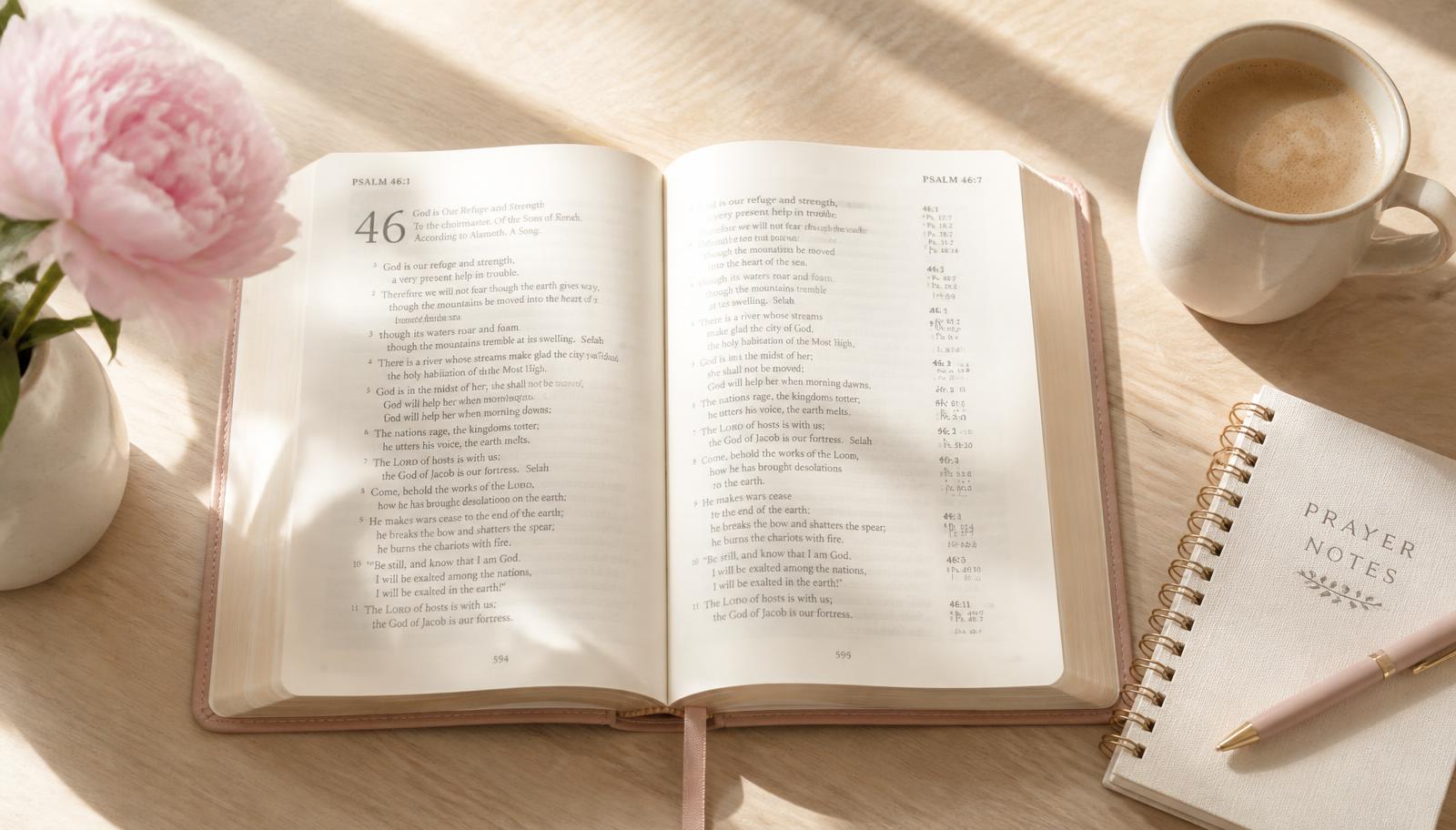
Anchor it to a habit you already have. Don't say "I'll read in the morning". Say "I'll read while I drink my coffee, sitting at the kitchen table". The old habit pulls the new one along.
Set it up the night before. Bible open to the right page, journal and pen beside it. Removing ten seconds of friction makes more difference than any amount of motivation.
Define a non-negotiable minimum. On impossible days — sick child, travel, a bad night's sleep — the minimum is one verse and one sentence of prayer. Two minutes. The goal is simply not to break the chain.
Accept the hour you actually have. Mornings have real advantages, but a devotional time at 9pm exists; a 6am devotional time that never happens does not. Choose the hour when you're genuinely awake.
When you miss a day (because you will)
You will miss days. A whole week, maybe. The rule is simple: don't catch up on what you lost, pick up where you are. Don't try to read the seven days you skipped. Open today's reading and carry on.
God isn't counting your missed days. He's simply glad you came back.
To start this week
Choose three things right now, and write them on a piece of paper:
- The time and the place (be specific)
- The book you'll begin with
- Your non-negotiable minimum for the hard days
That's it. No new journal, no complicated system, no waiting for the perfect Monday. Fifteen minutes, one passage, one sentence of prayer — repeated often enough to become who you are.
May this be the year you stop trying to be perfect and start being consistent.
Newsletter
Get new articles in your inbox
Join thousands of women receiving weekly inspiration in their inbox.
A quiet letter with everything written here about faith, home, wellness, beauty and lifestyle.